
Industry 4.0 is the broad shift toward connected, data-driven manufacturing, where equipment, systems, and people share real-time information across the plant. Pharma 4.0™ is the operating model, trademarked by the International Society for Pharmaceutical Engineering (ISPE) in 2017, that applies Industry 4.0 principles to regulated pharmaceutical manufacturing.
Unlike a generic buzzword, it has a specific origin and a specific structure, developed by ISPE's Pharma 4.0 Special Interest Group to help pharmaceutical organizations digitalize without losing sight of validation, audit, and quality requirements. The model is built around four operating quadrants, resources, information systems, organization and processes, and culture, and four supporting principles: interoperability, information transparency, technical assistance, and decentralized decisions.
That structure matters, because it draws a clear line between Pharma 4.0 and generic Industry 4.0. ISPE's model embeds regulatory best practices directly into the transformation, aiming to help pharmaceutical organizations leverage digitalization while staying aligned with global regulations.
In practice, this means the same connected, data-driven capabilities used across manufacturing broadly still need to hold up to validation, audit, and quality oversight in a pharma environment. The good news is that most of the practical building blocks look the same either way.
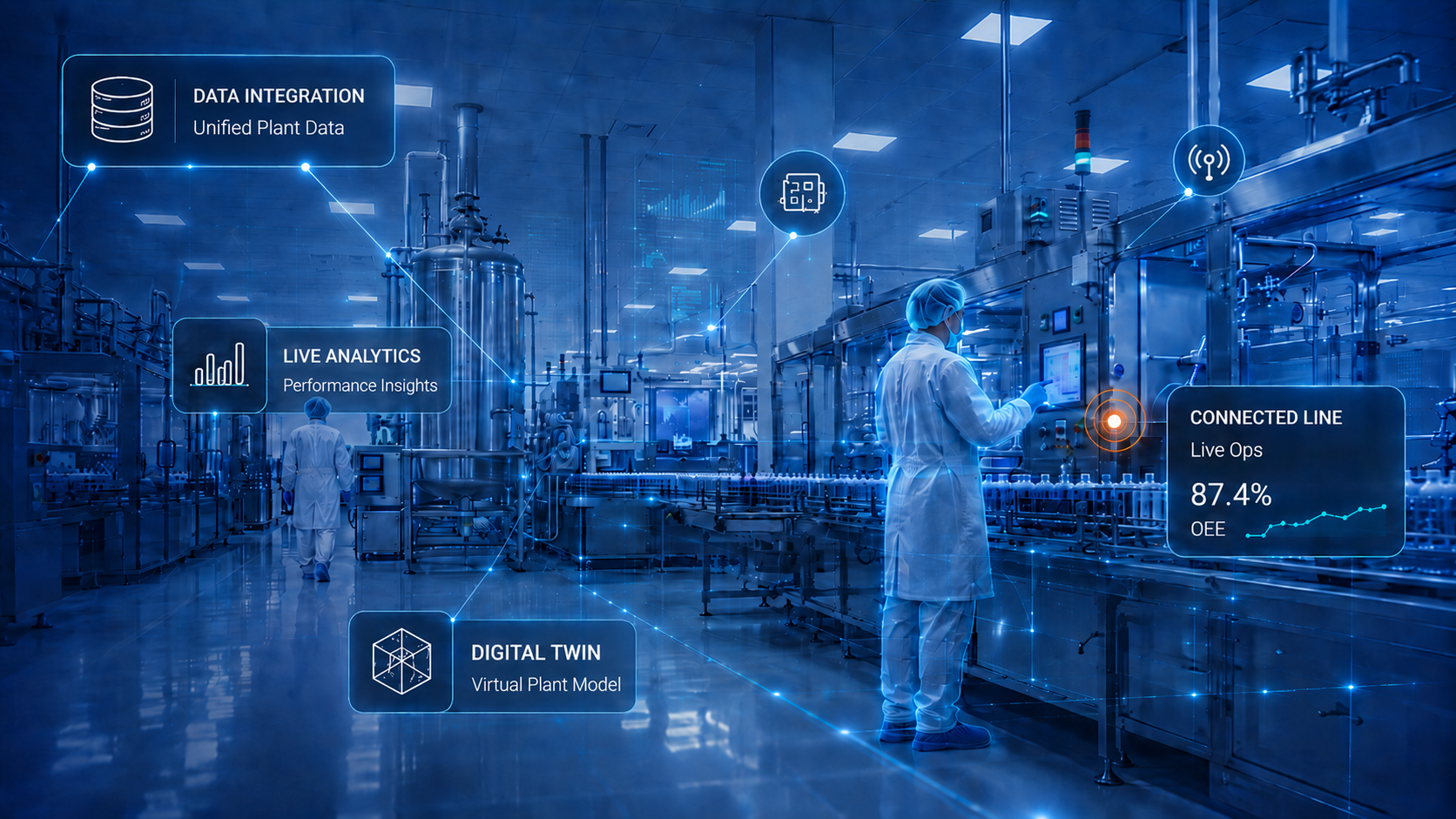
In practice, almost every Pharma 4.0 initiative worth pursuing is built on four building blocks: IIoT connectivity, data integration, digital twins, and mixed reality training.
IIoT and the Pharma 4.0 Data Foundation
The Industrial Internet of Things (IIoT) is the least glamorous of the four building blocks, and also the most foundational. At its core, it is about connectivity, getting sensors, PLCs, skids, and equipment to share real-time data instead of sitting on isolated islands.
Many plants still rely on a planner manually collecting numbers in a spreadsheet that the equipment already generated but had no useful way to share. IIoT closes that gap. Done well, it creates a unified namespace (UNS), a term coined by industrial IoT architect Walker Reynolds, a consistent way for every system to speak the same language, so data from the edge of the network reaches the people who need it, in a form they can use.
This is not about replacing a control system. It is about making sure the intelligence equipment already produces does not stay trapped where nobody can see it. Under the ISPE model, this connectivity layer supports the resources and information systems quadrants directly, since data visibility is the foundation everything else builds on.
Data Integration and Pharma 4.0 Information Transparency
Once data is flowing, the next challenge is making sense of it. In a GMP environment, that means pulling information from the manufacturing floor, the quality lab, and business systems, and getting it clean, consistent, and organized enough to actually analyze, and just as important, audit.
This is where electronic batch records earn their keep, and where data analytics starts to pay for itself: fewer manual reconciliations, faster investigations, and a clearer view of what is actually happening in a process versus what was assumed to be happening. Teams that make this shift often go from spending half their day chasing down numbers to spending that same time acting on them. That shift alone changes how a plant runs, and it speaks directly to the information transparency principle at the heart of the ISPE model.
Digital Twins — Testing Before You Build
A digital twin is a virtual representation of a process, a piece of equipment, or a supply chain, one that can be experimented on without touching the real thing. What happens to yield if a process changes before committing capital to it? How does a facility respond to a supply disruption before it actually happens? A digital twin makes it possible to answer those questions in software first.
For some organizations, this capability has meant the difference between guessing at capacity constraints and actually forecasting them, where planners go from spending most of their time collecting production data to spending it on scenario planning instead. That is not a hypothetical benefit. It is hours given back to the people who need them most, and better decisions made with the time they have.
Mixed Reality Training in the Pharma 4.0 Model
The last building block is arguably the most human. Mixed and augmented reality overlay real-time information directly onto the equipment operators and subject matter experts are already looking at, including status, performance data, and dynamic Standard Operating Procedures that adjust to what is happening in the moment.
For new hires, this means learning on real equipment with guided visual instruction, instead of a binder and a hope that it sticks. For experienced operators, it means faster troubleshooting and fewer errors, because the right information is layered right where they are looking. For compliance teams, it means SOPs that are actually followed as written, because the format makes it easy to. Horizon Controls Group has built real solutions in this space, including our own AweAR mixed reality training platform, and the short version is straightforward: this is not a novelty. It is one of the most practical training and compliance tools available to manufacturers today, and it lines up closely with the organization and processes and culture quadrants of the ISPE model, where technology only creates value once people actually adopt it.
Why Industry 4.0 Matters Now
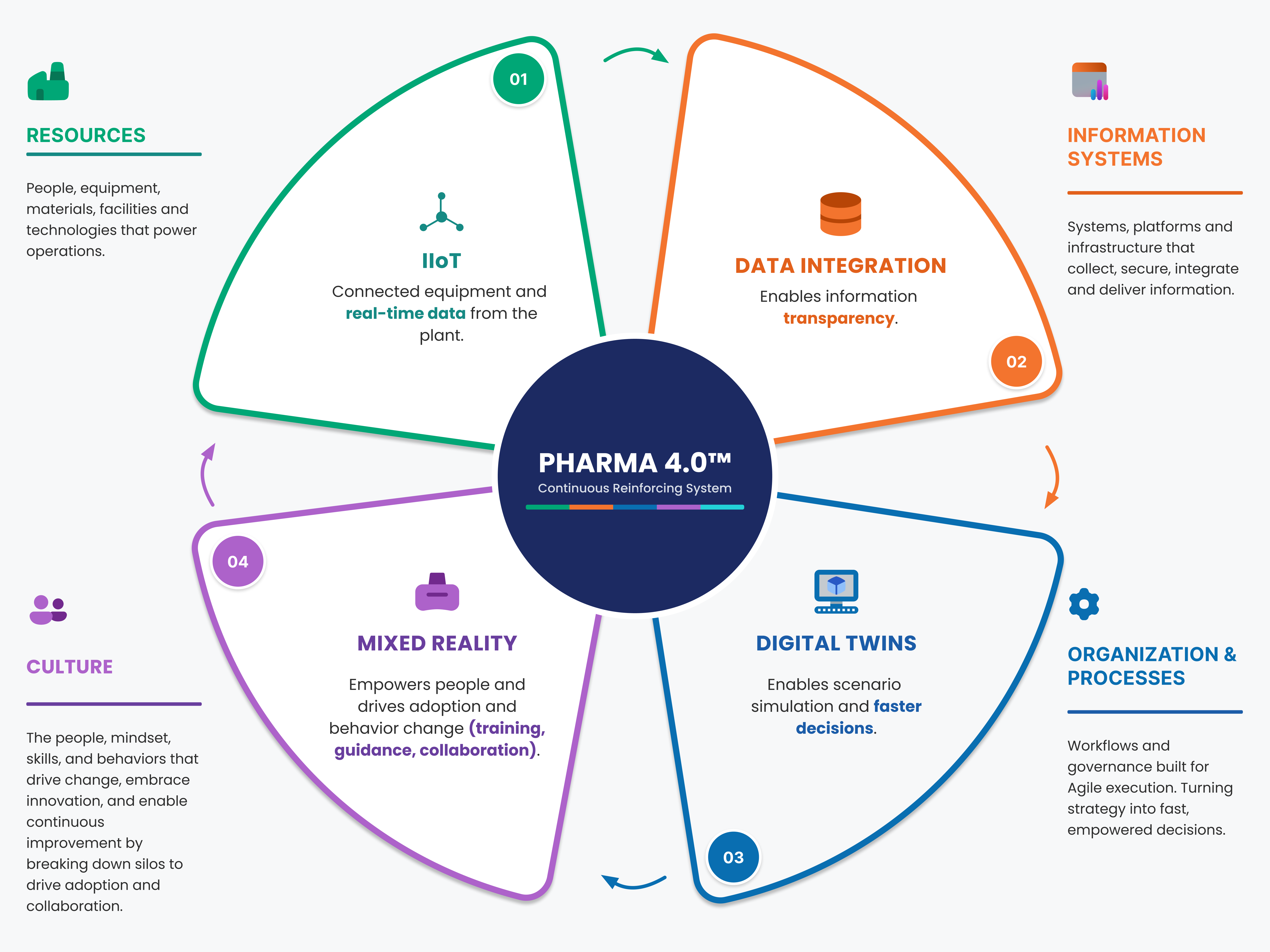
None of these four building blocks live in isolation. IIoT feeds the data that gets integrated. Integrated data is what makes a digital twin worth building. And digital twins, paired with mixed reality, are what actually get that intelligence into the hands of the people running the floor. Pharma 4.0, done right, is not four separate initiatives. It is one connected capability, built incrementally, on a timeline and budget that fit the operation, and aligned with a framework regulators and the broader industry already recognize.
Digital transformation does not require ripping out what already works. Some of the most successful projects start small and grow from there. A five-year roadmap is not the prerequisite. A clear first step is.
At Horizon Controls Group, we work alongside life sciences manufacturers at every stage of this journey, and the pattern is consistent: the projects that succeed fit the operation they're built for, not a vendor's roadmap. If you're weighing where to start, or whether you're further along than you think, our Smart Manufacturing team is happy to talk it through.
Industry 4.0 and Pharma 4.0 FAQ
What is Industry 4.0?
Industry 4.0 is the fourth industrial revolution in manufacturing: connecting equipment, systems, and people through IIoT, data integration, and digital tools so decisions are based on real-time information. In pharmaceutical manufacturing, it's applied through Pharma 4.0, which adds validation, data integrity, and regulatory requirements to the model.
What is Pharma 4.0?
Pharma 4.0 is an operating model, trademarked by ISPE in 2017, that applies Industry 4.0 technologies and principles to pharmaceutical manufacturing while embedding regulatory and quality requirements into the transformation.
How is Pharma 4.0 different from Industry 4.0?
Industry 4.0 is the broader manufacturing concept. Pharma 4.0 adapts it specifically for regulated environments, building in validation, data integrity, and audit readiness rather than treating them as an afterthought.
What are the four Pharma 4.0 building blocks?
In practice, most Pharma 4.0 initiatives are built on IIoT connectivity, data integration and analytics, digital twins, and mixed or augmented reality for training and compliance.
Do we need to replace our existing systems to adopt Pharma 4.0?
No. Pharma 4.0 is designed to layer onto existing validated systems incrementally, starting with one line, one process, or one training module, rather than requiring a full rebuild.